
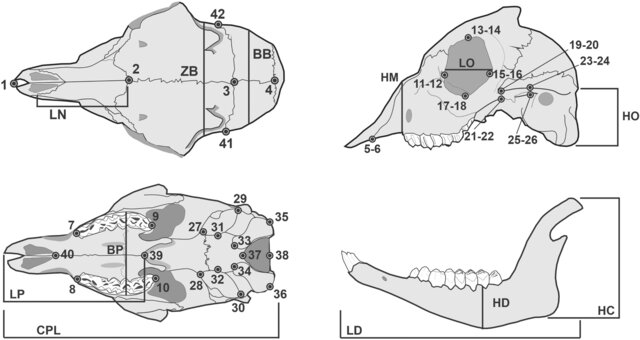
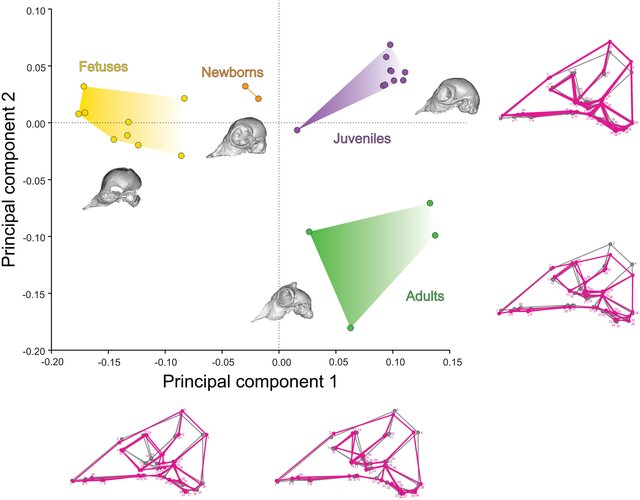
The skull is a key marker of morphological diversity in terms of ontogeny and phylogeny; however, prenatal growth patterns in mammals remain poorly understood. Changes in skull growth from embryonic to postnatal stages are influenced by multiple factors, including the maturity of offspring at birth within the altricial-precocial continuum, dietary transitions during the postnatal period, and the development of secondary cranial structures such as horns. In this study, we analyzed pre- and postnatal skull growth in goat (Capra hircus) using three-dimensional geometric morphometrics and linear allometry. Our results indicate that the cranial growth pattern exhibited a developmental shift between the prenatal and postnatal stages in which it deviated from a single continuous trajectory, thus revealing marked differences that became accentuated in adulthood. Prenatal and postnatal ontogenetic allometry differed significantly, with the prenatal phase displaying a comparatively higher growth rate in cranial variables associated with the splanchnocranium and neurocranium. These findings suggest that goats exhibit prenatal and postnatal growth strategies that are consistent with those of precocial mammals. Stage-specific allometric changes in the neurocranium and splanchnocranium align with different functional roles throughout development. The development of horns alters cranial morphology, thereby placing adults in a distinct position within the multivariate morphospace.
Segura, V., Flores, D. and Sánchez Villagra, M. R. 2025. From womb to maturity: Prenatal and postnatal cranial growth in goat (Capra hircus). The Anatomical Record n/a (n/a).
 | Valentina Segura Investigadora Adjunta CONICET Mastozoología |
 | Cristian Simón Abdala Investigador Adjunto CONICET Herpetológica |